
4th of July huge 30% off parts sale
Fastbackstack.com is having a huge 30% off eBay store wide parts sale starting July 4th through July 31st. The store will also be on Vacation mode meaning your parts would not be shipped until after July 20 but you can take advantage of a good deal. Parts for sale include 1964 – 1973 Mustang 1974 – 1978 Mustang II 1963 Fairlane 1966 – 1970 Ranchero 1970 – 1975 Maverick 1971 – 1973 Comet 1965 Comet 1964 – 1966 Falcon 1970 – 1971 Torino Ford F-100 F Series.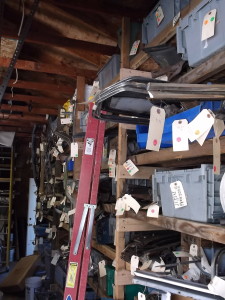
All Kinds of body parts, fenders, hoods, cut off sections, glass, wiring, trim moldings, brackets, panels, controls, heat and air conditioning, 9″ rear ends, 9″ 10″ 11″ drum brake parts, emergency brake arms, spreader bars, backing plates, disc brake spindles, rotors, hubs, Mustang II front suspension components, rack and pinion, drive shaft slip yoke, differential ring & pinion, Trac Lok Posi, Detroit locker, tail lights, tail light bezels, glove box, dashes, ash tray, consoles and more!
It would be worth taking some time shopping and scrolling through pages of parts listings I will not be able to answer any questions until after the 20th of July.
Thanks
Lee
1964 1/2 – 1968 Mustang Autolite 1100 1V Carburetors
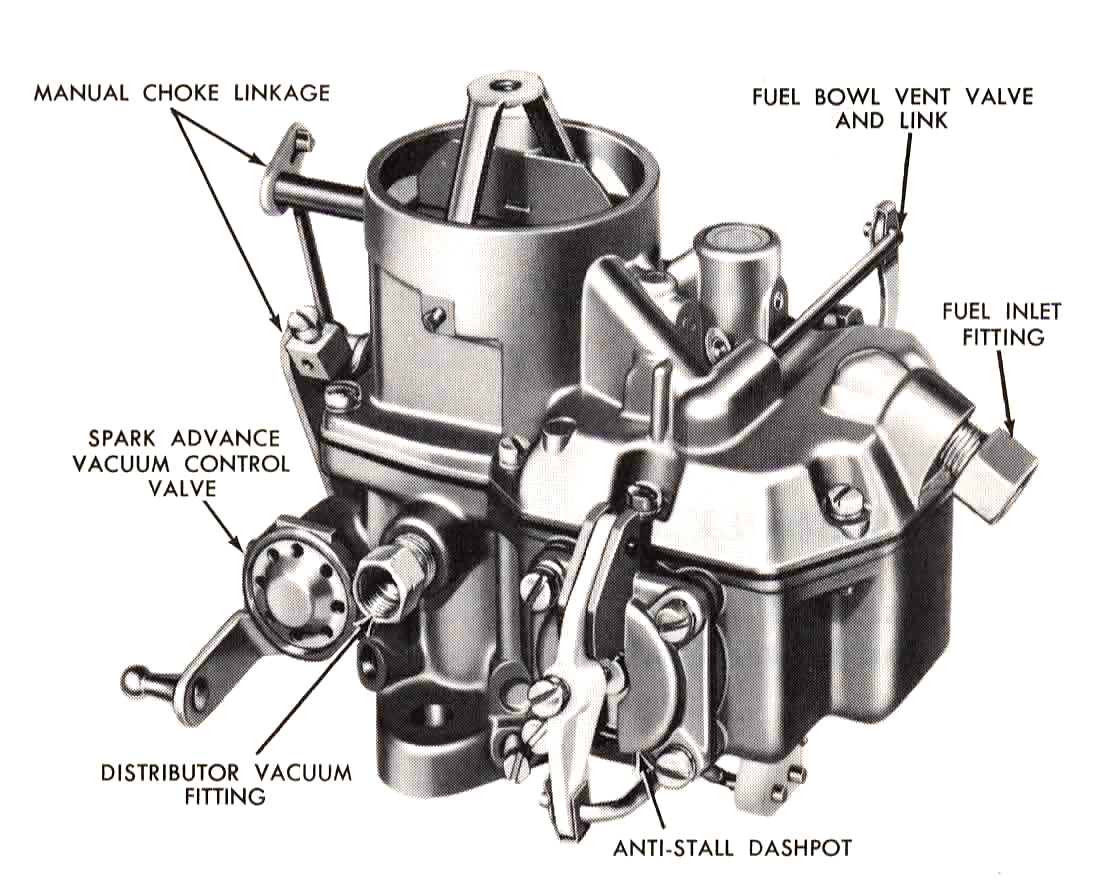
Autolite 1100 1V Carburetor
Autolite 1100 1V carburetors Was a good carburetor in its day. Used on Falcon Mustang Sprint Fairlane Comet 170 and 200 inline six cylinder engines. They are getting very hard to find and when you do find one only about 1 in 5 will function properly no matter who rebuilds or what they try to do to it. This is probably due to some internal wear issue that is un-restorable. Then a NEW one was reproduced but at a high cost. And even those re-production carbs had issues. About any carburetor can sit there and idle but other drive-ability issues are persistent.
Starting in about 1967 Holley made a 1V to take the 1100 Autolites place. The replacement Holley is hard to come by but a far better carburetor. They swap directly in place with little to no modification needed. Nearly every time the Holley can be successfully overhauled with very few drive-ability issues. i.e surging galloping hesitation stalling backfiring running rich or lean icing up flooding etc.The Holley uses the same air cleaner as the autolite 1100. By about 1970 the Holley 1V was casted with the block letters AUTOLITE but is still the Holley style. And likely also used on the 250 cid 6 Cylinder.
Holley Carburetors and Autolite parts can be found on www.fastbackstack.com
2015 Mustangs Northwest Roundup!

2015 Mustang Roundup
Bellevue Community College in Bellevue Washington
Will have a nice turnout of Shelby’s as well as every other type and year of Pony car. This year is the 50th anniversary of the Shelby and the 51st Birthday of the first Mustangs that rolled off the assembly line.
The actual production started March 9th 1964 and the introduction of the American Icon Classic debuted at the Worlds Fair in New York on April 17 th 1964. That day Ford recorded 22,000 Units sales. Thats 22,000 mustangs selling in one Day. Back in the day. Shelby’s were Considered 1965 and were introduced in the fall of 64 all having Standard interior. As the Pony interior and GT package was not an option until April 1965. The Shelby’s did have the Handling package Consisting of a special Pitman arm and idler arm. These were longer than the stock ones to make Manual steering much easier and Quick ratio 16:1. The Special steering gear box tag showing the HCC AX part number.
There were many other unique Performance Parts available as well and FoMoCo also offered K Code and HiPo engine upgrade and dress up kits ( over The Counter ). Back then new parts sales were just regular parts now they are NOS ( New Old Stock )
FastbackStack, LLC will be at the 2015 Mustang Roundup on Sunday, July 19th. Please come by and see us.
2013 Mustangs Northwest Roundup!
 2013 MUSTANG ROUNDUP:
With temperatures in the 80’s, it will be a beautiful weekend for the Mustang Roundup! Join us in Bellevue, Washington for the 33rd Annual Mustangs Northwest Roundup, where nearly 1,000 Mustangs come together for a spectacular car show! The MCA Regional Judged Show is on Saturday, July 20th from 7:00 a.m. – 4:00 p.m. On Sunday, July 21st, the popular “People’s Choice” show takes place from 9:00 a.m. – 5:00 p.m. Both events are located at Bellevue College. This is the “World’s Largest Annual Gathering of Mustangs”! Visit Mustangs Northwest for more details.
Stop by and see us at our vendor stalls located near the Classic Mustangs. We will have treats and free Mustang coloring books for the kids. Additionally, we will be bringing original Classic Mustang parts to sell. As always, if you need something in particular, just contact us and we’d be happy to bring it for you. Here is a list of some of the items we’ll have at the Roundup:
- Boxes of 1964 1/2 – 1973 Mustang interior, exterior and mechanical wiring
- 1968 Mustang consoles
- 1979 Mustang console
- 1970 – 1973 Mustang Space Saver spare tire
- 1966 Firestone Deluxe Champion spare tire
- 1966 Mustang all steel Shelby hood
- 1966 Mustang NOS hood
- 1971 – 1972 Mustang tilt steering column
- 1965 – 1972 Mustang miscellaneous hubcaps
- 1971 – 1973 Mustang Fastback and Convertible trim
- 1965 – 1973 Mustang radios
- Plus MUCH MORE!
Stop by our booth at the Roundup to check everything out. Just look for the FastbackStack signs and lots of Mustang parts!
2013 Portland Oregon Automotive Swap Meet

Portland Oregon Automotive Swap Meet
PORTLAND SWAP MEET: Are you attending the largest automotive swap meet on the west coast? The Portland, Oregon swap meet starts in 2 DAYS!! Located at the Portland Expo Center, this swap meet runs from Friday, April 5th through Sunday, April 7th. The swap meet is held in two locations: the Portland Expo Center and the Portland International Raceway. Visit the Portland Swap Meet for more details.
We’ll be there in all the action! Come see us at our vendor stalls #9009-9011, located at the Portland Expo Center (outside area). Some of the items that we’ll be bringing with us include:
- 9” Posi N Case 31 spline 3rd member axles
- 9” Posi 3.25 31 spline carrier
- 1957 Ford 9” rear end with axles
- 1969-1973 Maverick 8” rear end housing with axles
- Mexican 302 block
- 4V J code heads Date code May 23
- 1965-1966 Air Conditioning console (Convertible)
- 68 Deluxe consoles (3)
- 67 Deluxe seat-backs (2 sets)
- 67 Deluxe interior (2 sets)
- 70 Boss 302 Space saver spare tire
- Coupe, Convertible and Fastback misc. trim
- 1967, 1968, 1972 AM/FM radios
- 1964 1965-66, 1969, 1971 AM radios
- 1966-68 new carpets, seat covers, misc. interior parts
- 1965-68 Pony door lights, Deluxe door lights
- 1965-68 Trim panels
- 1969 Mach 1 gauges
- 1970 Fenders
- 1967-1968 Fenders
- 1971-1972 Fenders
- 1971-1973 Fastback trunk lids
- 1964-73 seatbelts (singles & sets)
- 1964-73 jack/hold downs – misc parts
- 1971-73 Fastback parts
- 1969-70 Fastback trim and parts
- 1971-72 Tilt steering
- 1967-68 A/C dash vents
- 1973 Mach 1 wheels (full set)
- 1968-69 Mercury Cyclone GT Dashes (black)
- 1969 429 SCJ Holley Carburetor
- 1966 and 1967 GT 390 4V Carburetor
- 1965-1966 6 Cylinder P/S complete rack
- 1966 Shelby all steel hood
- 1965 Shelby R model heater delete unit
- 1967 Shelby grille
- 1968 Shelby tail panel, tail lights and Shelby wiring
- 1968 Stuart Warner gauges (1968)
- 1968 GT wheels with hub caps (full set)
- NOS 1965-67 Export Brace
- NOS rocker trim
- NOS 140 mph speedometer
- NOS 1970 left hand strut rod, NOS bushings
- NOS 1966 Hood
- NOS 1965-1966 Rocker trim
- NOS 1967-1968 Console shifters (2)
- NOS odds and ends
- Plus MUCH MORE!
Stop by our booths at the Portland Expo Center to check everything out. Just look for the FastbackStack sign and lots of Mustang parts!
If you are planning on going to the swap meet and want us to bring anything in particular for you, just contact us today. If, by chance, you’re not able to attend but want us to keep our eyes open for particular Mustang parts, let us know that too!
Happy bargain hunting and we look forward to seeing you soon!
FastbackStack, LLC
P.S. If you would like to purchase something from our eBay store this week, please keep in mind that we will be gone from April 4th – April 7th. Our priority upon our return will be processing all orders that occurred while we were out.
Ford Autolite Carburetors
Ford made one of the best 4V carburetors when they developed the Autolite 4100 4bbl (4V carburetor). The Autolite 2100 2V was also one of the most trouble-free 2bbl carbs ever produced. In the early 1960’s the Autolite 1100 1V was used on the Ford Falcon and later on the 1964 ½ Mustang 170 cubic inch 6 Cylinder and the 200 as well.
Autolite carburetors, when properly tuned, will out-perform most of the competition. In the 1956 and 1957 Ford Thunderbird performance category, the 312 V8 was outfitted with the Tri-power multi-carburation setup. This unit was a factory Intake manifold with Three Stromberg 2V carburetors. With proper linkage and adjustments, the T-Bird would take flight.
Two of the rarest Autolite 4V’s were the 1.06 and 1.19 carburetor. These were used on the 1958 Mercury only. The Mercury Low Torque 383 V8 used the 1.06. The Mercury High Torque 383 used the 1.19 4V. This 1.19 Autolite carburetor has the highest CFM rating of any Autolite carburetor ever produced (it rates “669”).
Later in 1962 and 1963, Ford developed the FE series 390 and 427 Tri-power and Dual Quad Induction system. Ford utilized Holley carburetors for some of their high-performance applications. Standard and factory performance engines still commonly used the Autolite 1.08 and 1.12 venturi 4V units.
In 1964, the 260 V8 was only offered with a 2V intake manifold. This Autolite 2100 2V carburetor was a 1.01 venturi. Other 2V carburetor sizes were .98, 1.02, 1.06, 1.08, 1.14, 1.23 and 1.33.
Check out our Autolite carburetors we have listed in our eBay store.
1964 1/2 Mustang 170 6 Cylinder Engine vs. 200 CID Engine
From 1962 to 1964 1/2, Ford used the 170 cubic inch 6 cylinder engine. This was an inline straight 6. The 170 engine was discontinued in the summer of 1964. The 200 engine was used until 1978, at which time it was discontinued as well.
In 1965, Mustangs were outfitted with the 200 cubic inch 6 cylinder engine. At first glance, these engines look the same. There are some major differences, however. The main difference is a 170 engine block and crankshaft has four main bearing journals, while a 200 engine block and crankshaft has seven main bearing journals. Thus, the cranks and blocks are not interchangeable.
A noticeable difference between the two engines is the 170 engine has three soft freeze plugs on the right hand side (passenger side) of the block, while a 200 engine has five soft freeze plugs.
A subtle difference between the two engines is the timing cover. The 170 engine’s timing cover does not have a bolt hole in the bottom for an alternator or generator mounting bracket. The 200 engine’s timing cover has a bolt hole for mounting the alternator bracket.
1964 1/2 Mustang 260 V8 vs. Early 289
From 1962 to 1964 1/2, Ford used the 260 V8 engine. This engine was the predecessor to the 289. The 289 was developed in 1963. The main difference between a 260 and a 289 is the 260 has a 6 inch space between the motor mount bolt holes, while the 289 has a 7 inch space.
All 260 engines have a 5-bolt bellhousing bolt pattern. The 1963 and 1964 1/2 289 engines have the same 5-bolt pattern. The 260 has a smaller cylinder bore. Ford did not make a 260 4V engine. You can always add an early 289 4V intake to your 260 engine if you want to make a “D code” style engine (“D code” is a 1964 1/2 289 4V engine).
Reproduction Cowl Panel
Once your cowl panel is removed, you can look at its condition and decide which repairs need to be done. Often times, the lower cowl panel is in good shape and only needs to be cleaned and re-painted. However, if it is rusty, a patch panel will need to be installed. Dynacorn Industries offers a good reproduction repair panel. It is a complete lower cowl panel replacement, so you won’t need a patch panel.
I’ve used several of these and they work great. Keep in mind that this panel is patterned after a 1967 Mustang. So if you are using the panel on a 1965 or 1966 Mustang, you will need to drill an extra hole in the mounting flange of your left hand fresh air intake canister. 1967 Mustang fresh air intake canisters had more mounting stud holes than a 1965 or a 1966 did.
To achieve the proper placement of this extra hole, place your fresh air canister on the cowl prior to installation and mark the mounting flange.
Another thing to keep in mind: if you are repairing a 1965 Mustang cowl panel, make sure that your windshield wiper transmission protrudes high enough through the top of the exterior cowl panel. This ensures that you have enough of the wiper transmission protruding through to put the chrome bezel on it. If this isn’t done during installation, it is difficult to do once the painting has been completed.


